World Models: How AI Predicts What Happens Next
An AI system can describe a scene. Helping it anticipate the consequences of an action is a different challenge.
By Nouman Ahmad
A photograph can show a cup near the edge of a table. It cannot, by itself, show what happens when someone pushes it.
That gap between recognizing a situation and anticipating a consequence helps explain the interest in world models: models that represent aspects of an environment and predict how those aspects may change. For a system that takes actions, a particularly useful question is: what might happen if I do this?
The name sounds enormous. In practice, the “world” might be a video game, a robot's workspace, or a limited set of scenes. A world model does not have to describe everything, and calling something a world model does not establish that it understands the world as a person does.
Recent work illustrates both the promise and the variety. Dreamer learns behavior using predicted experience; Meta's V-JEPA 2 explores prediction and robot planning; World Labs' Atlas generates views under camera control. These are related ambitions with different outputs and tests. Dreamer study, V-JEPA 2 research, Atlas announcement.
Start with one possible action
Imagine a robot that needs to move a cup to a tray. This is a hypothetical example, not a description of an experiment.
A recognition system might identify the cup, the tray, and their locations. A decision-making system also needs to choose a movement. Should it push the cup, lift it, or move around an obstacle first?
A world model can help by predicting possible consequences. One candidate movement might leave the cup upright. Another might move it closer to the edge. The robot can compare those predictions before choosing what to try.
There are three distinct jobs here: representing the current situation, predicting a possible next situation, and deciding which outcome is desirable. A good predictor is not automatically a good decision-maker. The system still needs a goal and a way to evaluate actions.
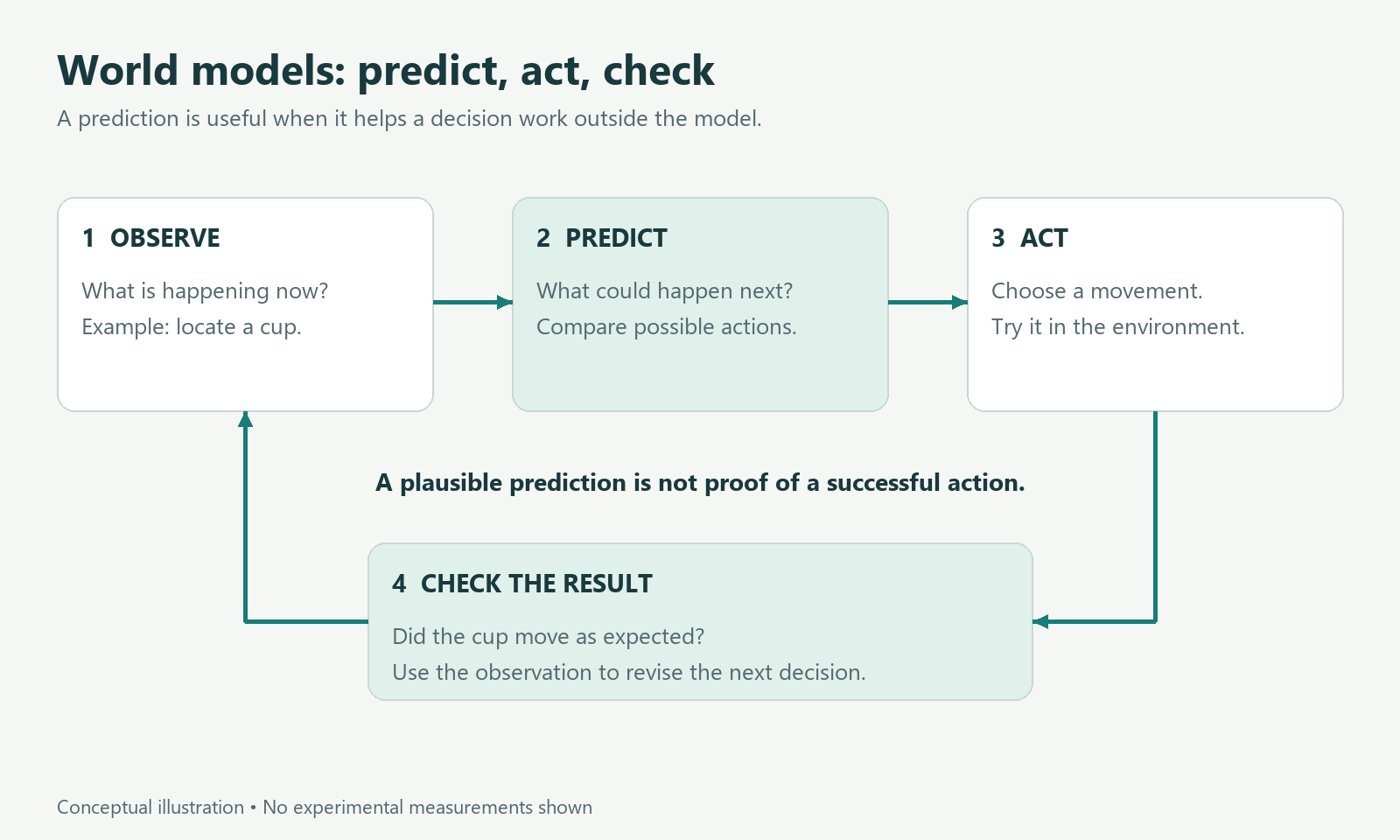
A simplified decision loop. Predictions support a choice; observations reveal whether the choice worked. Some systems use imagined experience during training rather than planning every action this way.
The prediction does not have to look like a video
One easy mistake is to assume that a world model must produce a realistic movie of the future.
Some models do generate visible scenes. Others predict changes in an internal numerical representation: a compact description that retains information useful for the task. Researchers often call this a latent representation. We cannot simply watch it as a video, but a controller may still use it to choose actions.
The influential 2018 World Models work combined a compressed representation, a predictive model, and a controller in virtual environments. Its experiments included learning a policy inside a learned environment and transferring it back to the original environment. This was a research demonstration in particular tasks, not a general simulator of reality. Ha and Schmidhuber's paper and interactive explanation.
For our cup-moving robot, that distinction is practical. A perfect reconstruction of the table's wood grain might contribute little to the movement. The cup's position, an obstacle, and the consequences of contact matter much more.
But compression creates a question: which details can safely be ignored? If the model overlooks a slippery surface, an efficient representation can still support a bad decision. “Compact” and “sufficient” are different claims.
Learning from imagined experience
Trial and error can be expensive. A physical robot takes time to reset; some mistakes damage objects. Predicting outcomes offers a way to explore possibilities before trying all of them outside the model.
DreamerV3 is a concrete example. In a peer-reviewed Nature study published in April 2025, the researchers evaluated the algorithm across more than 150 tasks using a fixed configuration. Its world model supports learning an action policy from imagined trajectories. The study also reports collecting diamonds in its Minecraft learning environment without human demonstrations or a curriculum. Hafner and colleagues.
This result needs two boundaries. The tasks provide evidence for the tested algorithm and settings; they do not prove unrestricted real-world competence. Also, a shared algorithm and configuration across tasks do not mean that one trained model already knows how to perform every task.
For the hypothetical robot, imagined practice would be useful only insofar as it teaches movements that work when the real cup is involved. Success inside the prediction system is an intermediate result. Success outside it is the reason to build the system.
Watching the world and acting in it
Videos contain information about movement, object interactions, and changing scenes. They are attractive training material, but watching something happen and knowing how to make it happen are different problems.
Meta's V-JEPA 2 research combines large-scale video learning with an action-conditioned model for robot planning. The researchers report using less than 62 hours of robot video for that action-conditioned stage and testing manipulation with Franka arms in two laboratories. The research page links an arXiv preprint; those results should be read in the context of the specified robots and tasks. V-JEPA 2.
Return to the cup. A video might show it sliding left, but the robot needs to know which motor command, from which starting position, would produce that movement. The meaning of an action depends on the body carrying it out.
This suggests a useful reading question for any new demonstration: does the model predict what will be seen, predict the effect of a controllable action, or actually help a machine complete a task? Evidence for one does not automatically establish the others.
A convincing scene is another kind of achievement
World Labs introduced Atlas in September 2026 as a model for spatial intelligence. Its announcement demonstrates generating views from image inputs while controlling camera movement. That offers an accessible illustration of a model inferring what a scene could look like from somewhere else. It is a company demonstration, not independent evidence of general physical reasoning. World Labs' Atlas announcement.
Imagine walking behind our table. A model might generate a plausible rear view of the cup. That is useful for some visual applications. It does not, on its own, establish that the model predicts the force needed to move the cup or what happens when it falls.
This is why “looks realistic” is an incomplete evaluation. The right test depends on the promised use. A tool for creating scenes and a model controlling a robot can both be impressive while needing very different evidence.
Where predictions become fragile
A prediction may be accurate for the next moment and unreliable over a longer sequence. A small error can affect the next prediction, which then affects the one after that. Ha and Schmidhuber also discuss a related problem: a controller can exploit imperfections in a learned environment. World Models discussion.
For our robot, a model that slightly underestimates how far the cup slides might favor several movements that look safe in succession. The actual cup could reach the edge much sooner.
A sensible evaluation would therefore ask more than whether a predicted frame resembles a recorded frame. Does using the model improve task completion? How does it behave in unfamiliar situations? Can the system notice when observation disagrees with prediction and revise its plan?
These are proposed evaluation questions, not a claim that every world model already answers them well.
What should readers look for next?
The useful question is not whether an AI “has a world model” in the abstract. Ask what it represents, what it predicts, which actions it supports, and how those predictions were tested.
Our cup-moving robot makes the distinction visible. Naming the cup is one achievement. Imagining a movement is another. Moving it successfully, noticing an error, and recovering are further achievements that need their own evidence.
World models are compelling because they can connect perception with consequences. Their value becomes clearer when we look beyond a convincing prediction and ask what better decision it makes possible.
Evidence checked 8 October 2026. Examples and diagram are explanatory illustrations. Research findings are attributed to their sources; no experiments were independently reproduced for this article.