Can We Tell Where an Image Came From?
Content Credentials can help us inspect an image's recorded history. Understanding what the image proves still takes judgment.
By Nouman Ahmad
A photograph appears in your feed. It shows an unusual bird in a city park. The caption says the species has returned after decades away.
Before sharing it, you might ask several questions. Was the image generated? Was it edited? Who supplied it? Was it actually taken in that park? Does it support the claim in the caption?
Those questions sound similar, but they require different evidence.
Content provenance means the recorded origin and history of a piece of content. Content Credentials, based on the C2PA standard, provide a way to associate that history with a digital file using cryptographic signatures. Depending on what was recorded, credentials can describe creation tools, editing actions, and other parts of the content's history. C2PA's explanation.
The central distinction is straightforward: an image's history can help us evaluate it, but a verified history does not automatically make every claim about the image true.
Three questions, three kinds of evidence
Keep our fictional bird photograph in mind. It is an explanatory example, not an actual news event.
The first question is about origin. What process produced the file, and what source stands behind the available record?
The second is about integrity. Does the file match the content bound to that record, and does the record validate? Has something changed in a way that the available credential does not cover?
The third is about meaning. Is this the species claimed in the caption? Was it photographed where and when the caption says? Does one sighting establish that a population has returned?
A provenance system mainly helps with recorded origin and history. A factual conclusion also needs evidence appropriate to the claim. C2PA's own guidance explicitly separates provenance from determining whether content is true, accurate, or factual. C2PA explainer, section 7.2.2.
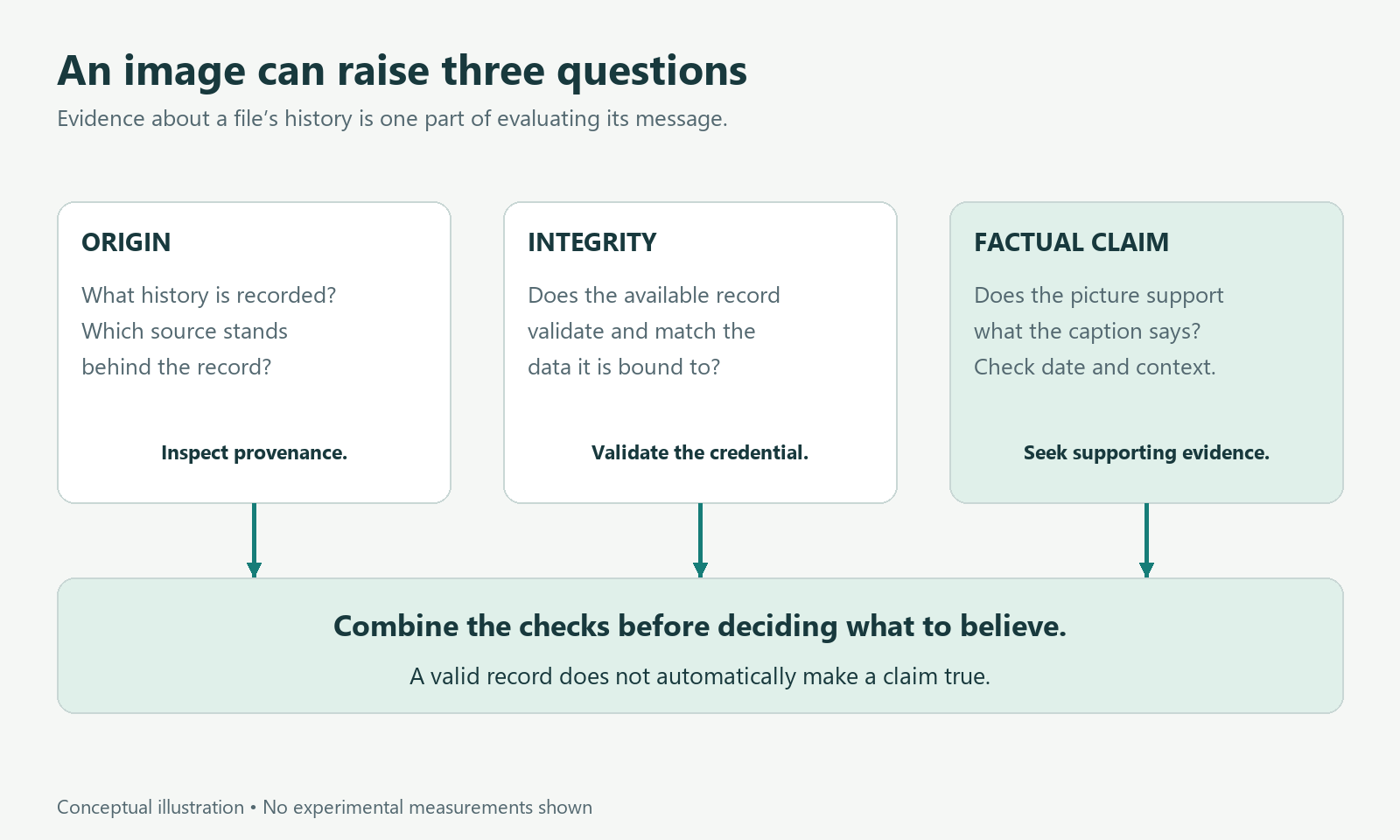
These are complementary checks. A successful check in one column does not automatically answer the others.
A signed record, not a magic badge
Ordinary metadata can contain information such as a caption or software name. The distinctive contribution of Content Credentials is that recorded assertions are connected through a signed structure and linked to the asset.
A cryptographic hash is a calculated value used to check the data covered by that binding. A digital signature supports checking the signed record against a certificate. Validation checks these relationships; it does not inspect the world to decide whether every assertion is honest. C2PA calls the structure a manifest. C2PA Technical Working Group's explanation.
For our photo, imagine a supported camera creates a credential, then compatible editing software records a crop in a subsequent credential. A viewer could inspect the available history instead of relying only on the appearance of the final image.
That is useful because a crop can change interpretation without inventing pixels. Cropping away a cage, for example, would matter to a claim about a wild bird. An editing record can prompt a better question even when the edit itself is technically ordinary.
Edited does not automatically mean deceptive
A photographer might adjust exposure or crop empty space. A scientific illustrator might deliberately generate a synthetic bird to explain a concept. Both can be legitimate when presented accurately.
The relevant issue is whether the content supports the purpose for which it is being used. A clearly labeled illustration can explain anatomy. It cannot serve as a photograph proving that a particular bird was seen in a particular park.
This is one reason a simple “AI or real?” label is too coarse for many situations. An image might begin as a camera capture, undergo ordinary editing, and later receive a generated addition. Understanding the recorded sequence can be more informative than forcing the entire file into one category.
C2PA supports recording actions and referring to source assets, called ingredients. Those source assets can have credentials of their own, although checking a complete ingredient history depends on access to the necessary information. C2PA FAQ on ingredient provenance.
For the reader, the useful habit is to inspect what a credential actually says. A visible icon is an invitation to examine evidence, not a complete verdict.
What if there is no credential?
Absence creates uncertainty, not an automatic finding of fakery. A photo may have been created with an unsupported device or passed through software that did not preserve the relevant information. C2PA's guidance cautions against treating all media without credentials as less trustworthy simply because the technology was not used. C2PA explainer, section 7.1.2.
Imagine two copies of our bird image. One comes directly from a participating publishing workflow. Another is a screenshot sent through a messaging application. The visible scene may look the same, but the available evidence about each file's history can differ.
Some implementations use methods such as watermarking or fingerprint matching to help rediscover a credential that is no longer embedded in the file. These are often called durable credentials. Recovery depends on the implementation and available matching information; it should not be assumed for every image. C2PA FAQ on removed metadata.
The appropriate response to missing provenance is to look for other evidence, such as the original publication and corroborating material, rather than deciding the image must be false.
Provenance and AI detection do different jobs
An AI-image detector examines content and estimates whether it has characteristics associated with generated material. A provenance system checks an available record and its relationship to the content. A watermark detector looks for a deliberately embedded signal.
These approaches can complement one another, but they have different failure modes. NIST's report on digital-content transparency reviews metadata, watermarking, and detection methods and emphasizes that no single method offers a comprehensive solution. Its evaluation guidance also highlights the damage caused by falsely labeling human-created material as synthetic. NIST AI 100-4.
Suppose a detector flags our bird image while no credential is available. That is a reason to investigate, not a sound basis for announcing that a photographer fabricated a sighting. The detector's tested reliability, the kind of image, and other evidence all matter.
Conversely, a credential reporting a camera capture would not establish that the caption's ecological conclusion is correct. The two tools address different parts of the problem.
Trust still has a human context
A technical system needs reliable implementations and secure signing processes. C2PA's technical working group describes conformance and security requirements for the products that create and verify credentials. A well-written standard alone cannot establish that every implementation behaves correctly. C2PA's technical explanation.
There is a separate identity question. A validated signing certificate should not automatically be read as proof of the identity of the person who pressed the shutter. C2PA's core specification focuses on provenance; additional mechanisms can support human or organizational identity claims. C2PA explainer, sections 7.2.4–7.2.5.
For our bird image, a careful reader would inspect the available history, identify what remains unverified, and then examine the caption's evidence. Perhaps the image is authentic but old. Perhaps the species identification is mistaken. Perhaps the photograph is correctly described, but one observation supports a narrower conclusion than the headline suggests.
None of those possibilities is resolved solely by the beauty of the picture or the presence of a credential.
Content Credentials can make part of the evidence easier to inspect. Their strongest contribution is helping us ask more precise questions about a file's recorded history. The next step remains ours: decide what that history, together with other evidence, actually supports.
Evidence checked 8 October 2026 against C2PA documentation and NIST's final 2024 report. The bird-photo scenario is fictional. The diagram explains concepts; it is not a credential-verification result.