When AI Agents Talk to Each Other
A simple guide to agent-to-agent interaction, the A2A protocol, and what makes collaboration useful.
By Nouman Ahmad
An AI assistant becomes more useful when it can act on a request: find information, use software, or prepare a document. A further possibility opens up when it can ask another AI agent to handle part of the work.
Agent-to-agent interaction means that software agents exchange information to coordinate what they do. They might delegate a task, request missing details, share a result, or challenge a conclusion. The exchange can involve ordinary language, structured data, or files.
There are two ideas to keep separate. Agent-to-agent interaction is the broad concept. Agent2Agent, usually shortened to A2A, is a specific open protocol for communication between independent agent systems. A team of agents can interact without using that protocol. A2A offers a common interface, especially when those agents come from different developers or organizations. Official A2A introduction.
To understand why this matters, follow one request as it moves between agents.
One request, several responsibilities
Imagine asking an assistant: “Help me write an accessible article about a new battery technology. Compare the evidence and explain the limitations.”
This is a hypothetical example. We are describing a possible design, not reporting a tested product.
Your main assistant could coordinate the work. A literature agent could find relevant papers. An analysis agent could examine whether their results are comparable. Your main assistant could then assemble a draft for you to review.
Those roles do not necessarily require different language models. Their useful differences might come from their instructions, access to information, tools, or responsibilities.
Now suppose the literature agent returns three promising studies. The analysis agent notices that one tested a small laboratory sample while another tested a complete device. It asks the coordinator for clarification before making a comparison.
That question matters more than the number of agents involved. A neat table could conceal an unfair comparison. A useful interaction brings the missing context back into the work.
The same idea applies to other settings: an assistant coordinating a delivery, software agents investigating a fault, or research services combining analyses. The common problem is deciding what to exchange, who should act, and how to assess the result.
What actually passes between agents?
We often describe this as agents “talking.” Underneath, software sends messages through interfaces. There is no need to imagine human awareness or a shared mind.
The A2A documentation separates a message, which carries a communication turn, from a task, which tracks a unit of work. A task can produce an artifact: a concrete output such as a document or dataset. Messages and artifacts can contain text, file content or references, and structured data. A2A core concepts.
In our example, “Please compare these studies” is a request. “I need the test conditions” is a clarification. The resulting comparison table is a deliverable.
A useful request should also make success understandable. “Research batteries” leaves much undecided. “Find three primary studies, record their test conditions, and flag results that should not be compared directly” gives the receiving agent something more concrete to work toward.
That is a design recommendation, not a guarantee supplied by a protocol. The application still has to define the job well.
Where the A2A protocol fits
Independent agents may use different software and keep their internal tools and memory private. A2A is designed to let them cooperate through an agreed interface without requiring access to those internals. It describes how to communicate with another system; it does not prescribe how that system must reason. A2A specification.
For our writing assistant, the interaction could unfold in four stages.
First, find a suitable agent. An A2A service describes itself through an Agent Card, including its skills, connection details, and authentication requirements. Think of it as a service description. A literature service might advertise paper-search capabilities. The card describes what it offers; its claims still need evaluation. Agent Card documentation.
Second, send the request and relevant context. The coordinator gives that service the research question, boundaries, and expected output. It should avoid sending unrelated private notes simply because they are available.
Third, follow the work. A short exchange may return an immediate message. Longer work can be represented as a task that reports progress, requests input, or ends as completed, failed, rejected, or canceled. This lets the coordinator distinguish “still working” from “needs help.” A2A task lifecycle.
Fourth, inspect the result. The coordinator receives the source list and passes the relevant material to the analysis agent. It must still check whether the delivered work satisfies the original request. A completed status tells us that the service has finished; the quality of its conclusion requires separate evidence.
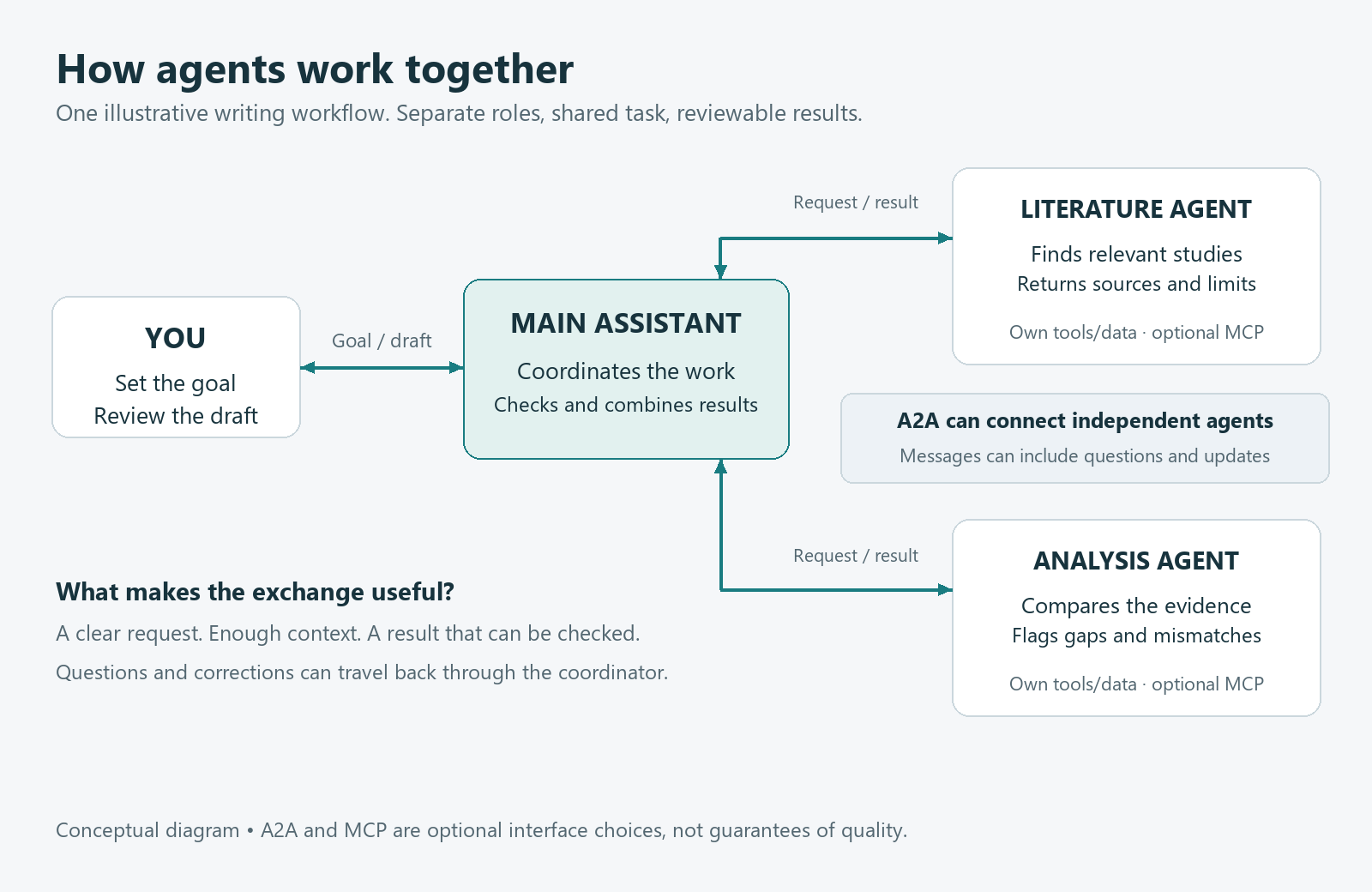
One possible arrangement: the coordinator manages the exchanges. A2A can connect independent agents; each agent may use MCP to access tools. Neither protocol is required for every implementation.
How is this different from MCP?
The Model Context Protocol, or MCP, standardizes connections to capabilities such as tools and resources. A2A focuses on interaction with an independent agent system. The official documentation presents them as complementary. A2A and MCP.
In our example, the literature agent might use an MCP connection to search a database. The coordinator might use A2A to ask that literature agent to investigate a question and return findings.
The distinction concerns the interface. A request to a tool asks for an exposed operation. A request to another agent can delegate work that involves several decisions and exchanges.
These are useful design distinctions, not rigid categories of intelligence. An agent can be exposed through a tool interface, and systems can combine approaches. Seeing “MCP” or “A2A” on a diagram does not establish how capable the underlying agent is.
Who coordinates the collaboration?
Our example uses a coordinator, but other arrangements are possible. Work might move along a chain, branch into several parallel tasks, or involve direct exchanges between agents.
Researchers have studied these differences. MultiAgentBench, published at ACL 2025, evaluates multiple coordination structures and measures progress toward task milestones as well as completion. Its comparisons include star, chain, tree, and graph arrangements. That gives us a useful research question: which communication structure suits which task? It does not establish one structure as best for every application. MultiAgentBench paper.
For the battery article, searching different sources could happen in parallel. Comparing the findings depends on having those sources first. A final writing step needs the comparison. The order should follow these dependencies.
The application or its coordinating agent makes those decisions. Adopting a communication protocol does not automatically produce a sensible work plan.
More agents come with costs
A real engineering example comes from Anthropic's 2025 account of its research system. It describes a lead agent delegating searches to other agents working in parallel, with particular benefits for questions requiring several independent lines of investigation. It also reports substantial additional token use and difficulties when work involves tightly connected dependencies. This is a company engineering report about its own system, not a universal performance law. Anthropic's engineering account.
For our hypothetical article, delegation could help cover several sources. But asking five agents to summarize the same short abstract could create repetition and extra review work.
Every handoff deserves scrutiny. Did a qualification disappear from the summary? Did two agents interpret the request differently? Did the coordinator mistake a confident answer for a verified result?
A practical test is whether the extra agents improve the finished work enough to justify the time, computation, and checking they introduce. Compare that outcome with a capable single assistant using suitable tools.
Sharing enough, without sharing everything
Collaboration also raises a boundary question: what may one agent reveal to another?
In our example, a literature service may need the article topic and search criteria. It probably does not need the author's unpublished correspondence. Different agents can belong to different organizations, so a shared task should not imply unrestricted access.
A2A's enterprise guidance separates identifying a caller from deciding what that caller is allowed to do. It places responsibility for authorization on the receiving implementation and recommends limiting access and shared data to what is necessary. A2A enterprise guidance.
This is also a research challenge. PAC-Bench, published in Findings of ACL 2026, evaluates collaboration in simulated scenarios with private information and explicit sharing restrictions. The authors report coordination problems including information disclosure, excessively vague communication, and invented information under those constraints. These findings concern the benchmark's evaluated settings; they are not a security test of the A2A protocol. PAC-Bench paper.
The practical implication is to design the exchange around the information needed for the task, then check whether those boundaries were respected.
What makes the interaction useful?
Return to the article draft. Three agents have contributed. The meaningful questions are now concrete:
- Can we trace important claims back to the original studies?
- Were incompatible measurements kept separate?
- Did uncertainty survive the handoffs?
- Did the agents stay within the agreed scope and permissions?
These are proposed checks for our example, not formal A2A conformance tests. They evaluate whether the collaboration served the reader's goal.
Agent-to-agent interaction creates a way to distribute work across systems with different capabilities. A2A provides a common interface for part of that interaction. Useful collaboration still depends on clear requests, appropriate information sharing, sensible coordination, and evidence that the work was done well.
When an AI product promises that its agents work together, ask what they exchange, and what becomes better because of that exchange.
Sources checked on 2 October 2026. The writing-assistant scenario and diagram are illustrative. Research findings and engineering observations are attributed to their sources; no independent software test was performed for this article.